


32nd Indian Art History Congress – A Fine Presentation on India's Art Culture and Thoughts
- A1 Raj
- 26 फ़र॰ 2025
- 2 मिनट पठन

32nd Indian Art History Congress – A Fine Presentation on India's Art Culture and Thoughts
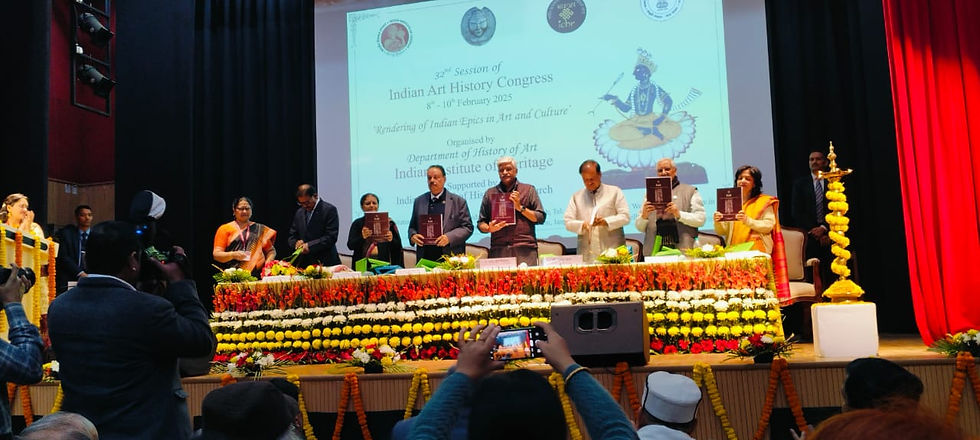
Organized at Indian Institute of Heritage, Noida (Uttar Pradesh), from 8th to10th February. 32nd Indian Art History Congress delivered a brief yet remarkable exploration on India's rich artistic culture and the varied forms of its creative elements. Eminent scholars, authors and art patrons, such as, prof. M.N.P. Tiwari, Prof, D. S. Somsekhar, Dr. U.S. Diwedi, Prof. (Dr.) Susmita Pande, Dr. T Satya Murthy, Dr. Sabyasachi Mukherjee, Dr. Sanjib Kumar Singh, Dr. Vinay Kumar, Pt. Uday Kumar Mallick, Prof. (Dr.) Sachchidanand Joshi, Dr. Sudipa Boss, Dr. Gopal Mandal, Dr. Usha Rani Tiwari, Dr. D. P. Sharma, Dr. Mohan, Dr. G. Bala Ji, Dr. Savita and many other distinguished art researchers addressed in this three-days long seminar.
On the central theme of Representation of Indian Epics in Art and Culture, the deep-rooted findings and discussions crossed the boundary of known and every recognized convention. They traced the inmost human sensitivity through which an art is formed. That, under societal perception create or reshape human culture, trends and traditions.

Participating scholars, for instance, Astha Sharma, Dr. Shivashankar, Dr. Arti Iyer, Riddhi Girish Joshi, Dr. Jasbindar Kaur said about unheard local or tribal multi-ethnic art forms, their influence and reflections in other regional creative compositions, like handicrafts, music and dance forms. Even while talking about the historic roots of art, researchers, such as, Dr. Kumud Kanitkar pointed out minute variations and diversions of representation mostly overlooked being offshoot of some regional culture. But, they all still are significant in terms of public sentiments or beliefs.
Finders like, Dr. Renu Shahi, Dr. Deepti Rekha Kauli, Dr. Alok Shrotriya and others talked about several variations of rural art forms, inter-regional art forms that developed out of different interpretation of India's most popular two epics– Ramayana and Mahabharata.

The session, although lasted for only three days gave so many interesting and complex findings that will take days or even more to explore and realize their actual implications. To the end, we must acknowledge India as a trove of cultural tradition, unique, unexplored in many areas and hence is an ever-expanding subject. Above all, the legacy of art can be said as the direct product of deepest human sentiments and expressions represented in its prettiest form as possible by the creator, known or unknown.

Article by - Arkaprava Das
Contributing Journalist in Royal Harbinger Weekly, Udaipur (Rajasthan), INDIA
Senior Academic and Research Content Writer
Amateur Photo Journalist


टिप्पणियां